Maybe We Misjudged Gen-Z
Every generation inherits a stereotype.
Baby Boomers are stubborn.
Millennials killed everything from napkins to home ownership.
And Gen Z?
Apparently, they're too busy making dance videos, chasing aesthetics, and replying with a single emoji to care about anything that actually matters.
It is a convenient stereotype. It explains every disagreement between generations without requiring anyone to ask whether the stereotype is even true.
Then something unusual happened.
A generation accused of having the shortest attention span in history refused to look away.
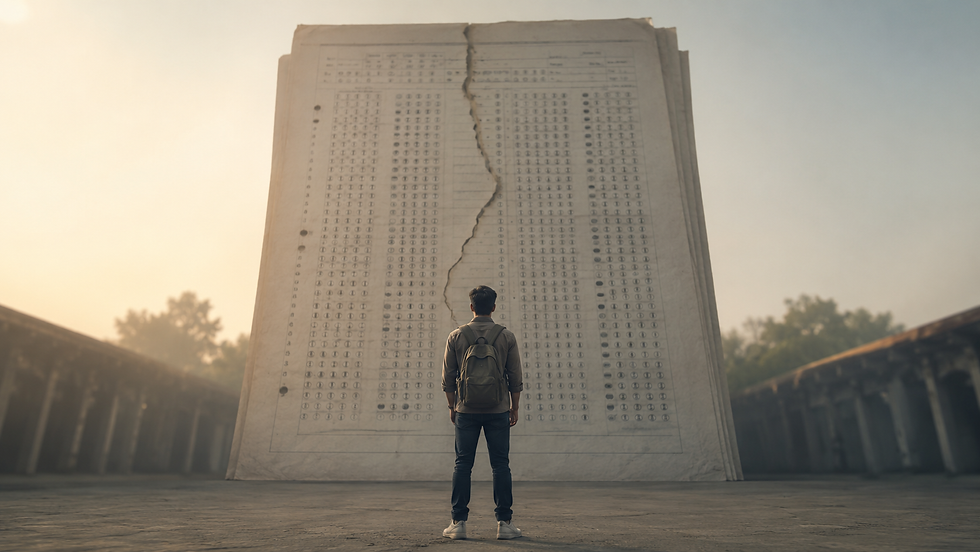
They marched because an exam had been compromised. They stayed because they believed something much larger had been damaged. Not just a question paper, but the quiet promise every student grows up with: if you study hard, play by the rules, and do everything you're told, the system will do its part too.
Whether one agrees with every slogan, every protest, or every decision made along the way is a different conversation. What is difficult to ignore is this: thousands of young people, many participating in public demonstrations for the first time, organised, persisted, and kept the issue alive long enough to force the country's attention.
Perhaps the first lesson from this movement has nothing to do with politics.
Perhaps we simply misjudged Gen Z.
The Protest Was Never Just About an Exam
If there is one thing adults often forget, it is that an examination is never just three hours inside a classroom.
It is months, sometimes years, of cancelled plans, early mornings, late nights, anxious parents, coaching classes, mock tests, and the quiet belief that effort will eventually be rewarded. For millions of students, examinations are not merely assessments. They are gateways that shape careers, financial security, and, in many cases, an entire family's hopes.
That is why reducing this movement to "students protesting an exam leak" misses the point entirely.
An exam paper can be reprinted.
Trust cannot.
When news of the leak spread, students weren't simply reacting to a compromised test. They were reacting to the possibility that someone else's shortcut could outweigh years of honest preparation. It challenged one of the few promises society makes to young people: work hard, compete fairly, and your effort will matter.
That promise is bigger than any single examination.
It is also why the protests resonated beyond those directly affected. Even people who had never appeared for that particular exam understood the frustration. Almost everyone knows what it feels like to invest time, discipline, and hope into something that is supposed to be fair.
Whether the government eventually announced compensation, initiated investigations, or accepted political responsibility through a resignation, those were responses to the crisis. They were not, by themselves, the resolution of it.
Because the real question was never, "Who leaked the paper?"
The real question was, "How do we make sure students can trust the system again?"
When the Protest Becomes the Story
Public movements have a curious habit. They begin with one question but rarely stay there. As more people join, the conversation expands. What started as a demand for a fair examination soon finds itself sharing space with debates about policing, politics, media coverage, and public order. None of these conversations are unimportant, but they all compete for attention with the issue that brought people together in the first place.
The reason isn't necessarily bad intent. Every institution responds according to its own incentives. News organisations look for compelling visuals, political parties interpret events through their own priorities, and social media rewards outrage far more generously than nuance. An examination reform may affect millions, but it is unlikely to outperform a video of a confrontation on anyone's feed.
That is why every protest faces two battles. The first is to make people listen. The second is to ensure they are still listening to the original question. The recent student movement reminded us that public pressure can force accountability. It also reminded us how easily the conversation can drift from "How do we fix the system?" to "Who won the argument?" The difference between those two questions often decides whether a movement leaves behind lasting reform or just memorable headlines.
Accountability Is a Milestone, Not the Destination
The resignation of the Education Minister was undoubtedly significant. Democracies function on the principle that public office carries public responsibility, and resignations are one of the clearest ways that principle is expressed. For many students, it was also validation that their concerns could not simply be brushed aside.
But accountability and reform are not interchangeable.
A leaked examination paper is rarely the result of one person's decision. It points to weaknesses in processes, oversight, technology, and coordination. Replacing a minister may acknowledge that something went wrong, but it does not automatically answer the more difficult questions. Have the vulnerabilities been fixed? Are future examinations better protected? Will students preparing next year have greater confidence than those who protested this year?
Those questions are far less dramatic than calls for resignation, which is perhaps why they receive far less attention. Institutional reform rarely produces viral moments. It happens through audits, policy changes, tighter safeguards, and months of administrative work that never trends online. Yet those quiet changes are often the difference between resolving a crisis and merely surviving one.
If this movement succeeds in leaving behind a stronger examination system, its legacy will extend far beyond a ministerial resignation. If it doesn't, another generation of students may find themselves marching for the very same reasons.
A Democracy Needs Both Protest and Procedure
Peaceful protest is one of democracy's greatest strengths. It gives ordinary citizens a way to be heard when they believe institutions have failed them. History is full of reforms that began with people refusing to accept the status quo. Without public pressure, many important conversations would never have reached the people in power.
At the same time, democracies cannot rely on protests to become the default route to every decision. If every major policy, appointment, or resignation depends solely on who can gather the largest crowd, institutions gradually lose the authority they were created to exercise. Public opinion is essential, but so are independent investigations, transparent processes, and the rule of law. A healthy democracy needs both. One keeps the other honest.
Perhaps that is the challenge this movement leaves behind. The students succeeded in ensuring that their concerns could not be ignored. The harder task now belongs to the institutions themselves. They must prove that accountability is not something they deliver only when public pressure becomes impossible to ignore, but something built into the system from the beginning. If that lesson is learned, this protest will be remembered for more than the headlines it generated. It will be remembered for strengthening the very institutions it questioned.
Maybe We Misjudged Gen Z
For years, we described Gen Z as distracted, impatient, and glued to their screens. Yet when they believed the rules of the game had been broken, many of them did exactly what every democracy hopes its citizens will do. They questioned institutions, demanded accountability, and refused to let the issue disappear after a single news cycle. Whether one agreed with every slogan or every strategy is beside the point. Indifference was never the problem.
The real test, however, was never whether students would show up. It was whether the institutions they challenged would respond with more than temporary fixes. Trust, once shaken, is difficult to rebuild. It returns not through speeches or resignations alone, but through systems that become more transparent, more reliable, and more deserving of the faith placed in them.
Perhaps that is the lasting takeaway from this movement. It wasn't simply a story about an examination, a protest, or even a resignation. It was a reminder that young people still care deeply about fairness, and that democracies are strongest when citizens demand better while institutions are willing to become better.
Maybe we didn't misunderstand Gen Z because they were different.
Maybe we misunderstood them because we weren't paying enough attention.


Comments